lunes, 9 de enero de 2012

Go to London!


Here's a short list of links to webpages with exercises of English about London. I thought that, after the new year, the new year´s resolutions, the holidays, the trips to London and so on, some of you might welcome this opportunity to brush up your English.

Aquí teneis una pequeña lista de páginas web con ejercicios acerca de Londres. Se me ocurrió que, tras el año nuevo, sus resoluciones, las vacaciones, los viajes a Londres, etc, a algunos de vosotros os vendría bien esta oportunidad de poner vuestro inglés a punto.

The first is for those of you who know the place. La primera es para los que conoceis la ciudad:

http://www.englisch-hilfen.de/en/exercises/countries/sights_london.htm

The second is a short text, very easy, on the Tower of London. El segundo, muy sencillo, es sobre la Torre de Londres: http://www.tolearnenglish.com/exercises/exercise-english-2/exercise-english-7057.php

Next is a series of printables, powerpoints and on line exercises. El siguiente es una serie de presentaciones, ejercicios on-line y páginas fotocopiables con ejercicios: http://www.eslprintables.com/buscador/buscar.asp?nivel=any&age=0&tipo=any&contents=london

This is highly recommendable for those preparing a trip to London. Este, para los que esteis preparando un viajecillo a Londres: http://blocs.xtec.cat/londontourist/category/exercises/

And this, for the return. Y éste, para la vuelta:
http://www.englisch-hilfen.de/en/exercises/countries/london.htm

I hope you like it and make the most of it if your new year´s resolution was about learning English!

Espero que os guste y lo aprovecheis si habeis decidido aprender inglés desde el Año Nuevo!

miércoles, 30 de noviembre de 2011

English Food (I'm hungry today!!)


VERY BRITISH MEALS

The first meal of the day in the morning is breakfast (usually eaten between about 7:30 and 9:00). Many British people eat toast with butter or margarine and jam (often strawberry, raspberry, apricot or blackcurrant jam), marmalade (a type of jam made from oranges) or Marmite (a dark brown spread made from yeast). Melon, grapefruit or fruit cocktail are popular. Others eat a bowl of cereal; for example, cornflakes or muesli with milk, or porridge (a mixture of oats, hot milk and sugar).

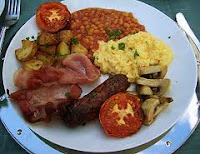
A traditional English breakfast (also known as a cooked breakfast or a fry-up) is a cooked meal which may contain food such as sausages, bacon, kippers (herring - a type of fish - which has been covered in salt and smoked), black pudding, scrambled or fried or poached egg, mushrooms, fried tomatoes, baked beans, hash browns and toast. People sometimes eat a boiled egg, dipping (dunking) strips of toast (soldiers) into the egg yolk. A continental breakfast is a small meal and is not cooked; for example, a bread roll or croissant with cheese or ham and a cup of coffee. The most common drinks at this time of day are orange juice or a cup of breakfast tea.
Many people have a tea-break at about 11:00 in the morning (elevenses). If a meal is eaten in the late morning instead of both breakfast and lunch, it is called brunch.

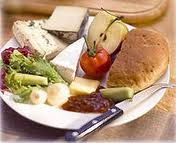
Lunch (sometimes called more formally luncheon) is the meal eaten in the middle of the day (usually between about 12:30 and 2:00). Many people eat a sandwich (also known as a butty or sarnie in some parts of the UK). Some people have a simple meal such as cheese and biscuits or soup and bread. A ploughman's lunch is a traditional lunch for farmers: a bread roll, Cheddar cheese, Branston pickle and salad, perhaps with a pork pie. It is also traditional for people to go to a pub with some friends for a pub lunch and a drink.

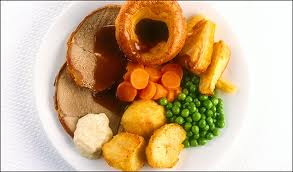
A Sunday roast is a traditional meal eaten by a family at Sunday lunchtime; for example, roast beef with roast potatoes, parsnips, peas, Brussels sprouts, green beans, York
shire pudding, bread sauce and gravy. Mint sauce or redcurrant jelly is often eaten with lamb, apple sauce with pork, and horseradish sauce (a type of mustard) with beef, cranberry sauce with turkey. Stuffing may be eaten with chicken or turkey.


Tea-time is a small meal eaten in the late afternoon (usually between about 3:30
and 5:00). People may drink tea, and often eat biscuits (American English: cookies), cakes or savoury foods such as sandwiches, crumpets or tea-cakes. Occasionally people may have a full afternoon tea or a cream tea: this includes a scone with jam and cream (usually either whipped cream or thick clotted cream) as well as a selection of sandwiches and cakes.
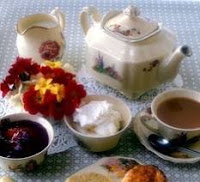
High tea is a light meal eaten in the early evening (for example, 6 o'clock) served with a pot of tea; this is popular in north England and Scotland. Supper is the most common name for the meal eaten in the evening (usually between 7:00 and 8:30). Dinner is another common name for supper, but sometimes it is also used to refer to lunch, especially when this is the main meal of the day.

A dinner party is a formal evening meal to which guests have been invited. A common type of cooked meal in Britain is meat and two veg. This is a meat dish served together on the same plate with two types of vegetable, one of which is often a type of potato. It is common to eat a dessert (also known as a pudding, or informally as afters) after the main dish.


COMIDAS MUY BRITISH


La primera comida del día, por la mañana, es el desayuno (por lo general se toma entre las 7:30 y 9:00). Muchos británicos toman tostadas con mantequilla o margarina y mermelada (a menudo fresa, frambuesa, albaricoque o de grosellas negras), mermelada amarga (de naranjas) o Marmite (una oscura plasta marrón hecha de levadura). El cóctel de melón, naranja o frutas es muy popular. Otros toman un plato de cereal, por ejemplo, cereales o muesli con leche o gachas (una mezcla de avena, leche caliente y azúcar). Un desayuno tradicional Inglés (también conocido como un desayuno caliente) es una comida cocinada que puede incluir alimentos tales como salchichas, tocino, arenques ahumados, pudín negro, huevos fritos, revueltos o escalfados, champiñones, tomates fritos, habichuelas, patatas y pan tostado. A veces la gente toma un huevo cocido, y tiras de pan tostado para en la yema de huevo. Un desayuno continental es una comida pequeña y no caliente, por ejemplo, un bollo de pan o croissant con queso o jamón y una taza de café. Las bebidas más comunes en esta hora del día son el zumo de naranja o una taza de té de desayuno.
Muchas personas tienen un té-break a las 11:00 de la mañana. Si una comida se toma al final de la mañana en vez de desayuno y el almuerzo, se llama brunch.

El almuerzo es la comida se come a la mitad del día (generalmente entre las 12:30 y 02:00). Muchas personas toman un sándwich. Algunas personas toman una comida sencilla, como el queso y galletas o sopa y pan. Un almuerzo de "labrador" es una comida tradicional de los agricultores: un bollo de pan, queso Cheddar, Branston pickle y ensalada, tal vez con un pastel de cerdo. También es tradicional que la gente vaya a un bar con unos amigos para una comida de pub y una bebida.

El asado de los domingos es una comida tradicional familiar a la hora del almuerzo dominical, por ejemplo, carne asada con patatas asadas, nabos, guisantes, coles de Bruselas, judías v erdes, el pudín de Yorkshire, salsa de pan y salsa. Salsa de menta o gelatina de grosella se come a menudo co n el cordero, salsa de manzana con carne de cerdo y salsa de rábano picante (un tipo de mostaza) con salsa de arándanos carne de res, de pavo. El relleno se puede comer con pollo o pavo.

La hora del té es una pequeña comida para la tarde (por lo general entre las 3:30 y 5:00). La gente puede beber té y comer galletas, alimentos salados o dulces, como bocadillos, bollos o pasteles de -. En ocasiones la gente disfruta una tarde de té completo: esto incluye un panecillo con mermelada y crema (por lo general ya sea de crema batida o crema de leche espesa), así como una selección de sándwiches y pasteles.

La merienda es una comida ligera comida en la tarde (por ejemplo, a las 6) se sirve con una taza de té, lo que es popular en el norte de Inglaterra y Escocia. Cena es el nombre más común para la comida de la noche (generalmente 7:00-08:30) pero a veces también se utiliza para referirse a la comida, sobre todo cuando es la comida principal del día. Un tipo común de comida cocinada en Gran Bretaña es de carne y verduras. Este es un plato de carne servido en el mismo plato con dos tipos de verdura, una de las cuales es a menudo un tipo de patata. Es común comer un postre (también conocido como un flan, o informalmente como afters) después del plato principal.



domingo, 16 de octubre de 2011

English for Tourism


This post is a blend between the spirit and aim of this blog and my own professional background, that is, learning English and Tourism studies. I’ll be recommending a few links for those into learning English for Tourism

Este post es una mezcla entre el espíritu y finalidad del

blog y mi própia experiencia profesional: aprender inglés por un lado y el turismo por otro. Os voy a recomendar unos cuantos links para los que estais interesados en el aprendizaje del inglés para turismo.

http://englishfortourismstudies.blogspot.com/

Este blog es para todos los que se interesan por aprender/enseñar inglés para turismo. Esta blogera lleva enseñando Inglés para Turismo 10 años y trabaja en la Universidad de Huelva.

This blog is meant for everybody who is interested in the teaching-learning of English for Tourism. This blogger has been teaching English for 10 years and works at the University of Huelva, Spain, where she teaches English for Tourism.

http://www3.turistica.si/sarolta/wp/?page_id=456

Šarolta Godnič Vičič is a blogger and teacher whose weblog is for students of tourism who are

learning English for tourism purposes. Its aim is to complete his classes, the coursebook and the e-classroom with up-to-date posts that deal with tourism and learning English for tourism.

Šarolta Godnič Vičič es un blogero y profesor de inglés para turismo que completa sus clases, el libro de texto y un aula virtual con posts actualizados que tienen que ver con turismo y con la lengua inglesa.

http://www.audioenglish.net/english-learning/efl_travel_pg_1.htm

AudioEnglish.net es la web más grande del mundo, según su publicidad, para aprender y practicar inglés. Ofrece 150.000 páginas con 2.500 ficheros de audio. Podemos escuchar acentos británicos y americanos (Oxford, Londres, Escocia, Nueva York, California y Canadá), desde cualquier ordenador, a cualquier hora y en cualquier sitio. También podemos practicar pronunciación y hacer tests online.

AudioEnglish.net
is the largest English-learning website in the World, according to their advert.
It offers over 150,000 pages with 2,500 audio files. We can listen to British and American English native speakers from Oxford, London, Scotland, New York, California and Canada
from any computer, anytime, anywhere. We can listen to audio, practise pronunciation and then check out the online tests.

http://www.eslflow.com/Tourismlessons.html

Esta es una recopilación de ejercicios de tema turístico, sobre todo en .pdf para poder descargar. No es la calidad sino la variedad de ejercicios lo que hace interesante esta página.

This is a compilation of exercises on English for tourism, mainly in .pdf format to download. This page is interesting for the variety, not so much for the quality of the exercises.

http://show.langschool.eu/courses/intermediate-en/unit04.es.html

A couple of units on tourism. Not much fun, or variety, but it is easy to use, it offers audio practice and self-correction, which is not bad at all.

Un par de unidades sobre turismo. No especialmente divertida, o novedosa, pero es fácil de usar, incluye práctica de audio y auto corrección, lo que no es poco.

http://www.britishcouncil.org/professionals-specialisms-tourism-intro.htm

This resource by British Council is like a short course book of English for Tourism; it offers a number of units, carefully divided in topics that Could be very well listed in any table of contents of a good, advanced book.

Este recurso on-line del British Council parece un libro de texto de inglés para turismo. Ofrece una cantidad considerable de temas que muy bien podrían aparecer en cualquier índice de un buen libro de nivel avanzado.

http://www.mluisaochoa.com/proyectos/turismo/

This web, by a team of lecturers of the University of Huelva, Spain, offers a compilation of on-line material related to the learning and practice of English for Tourism.

Esta web, de un grupo de profesores de la Universidad de Huelva, ofrece una recopilación de material on-line para el estudio y aprendizaje del Inglés para Turismo.

miércoles, 31 de agosto de 2011

1666 and all that!


England, and the UK, are as we know today because of a battle that took place in Hastings in 1066. London is as we know today because of a fire that took place in 1666!

In 1666, Sept. 2nd, the -quite dramatically known since then- Great Fire of London began at Mr Thomas Farynor's bakery in Pudding Lane. 400 streets, 13,200 wooden houses, churches, hospitals, bridges, schools, prisons
and even the first St Paul's Cathedral were destroyed. Amazingly, only nine people died. One good thing of the fire is that it ended the bubonic plague of the previous year. Another is that, thanks to the fire, the whole city had to be rebuilt and Sir Christopher Wren, the greatest architect of the day, did a very good job!
Today, "The Monument" stands to commemorate the fire. Interestingly enough, its length is the same as the distance between where it stands today and Mr Farynor's bakery.

Inglaterra, y el Reino Unido, son como los conocemos actualmente debido a una batalla que tuvo lugar en Hastings en 1066. Londres es como la conocemos actualmente debido a un fuego que tuvo lugar en 1666.

El dos de septiembre de 1666 el Gran Fuego de Londres, como dramáticamente se le conoce desde entonces, comenzó en la panadería de Thomas Farynor en Pudding Lane.

Se destruyeron 400 calles, 13200 casas de madera, escuelas, iglesias, hospitales, puentes, cárceles e incluso la primera catedral de San Pablo. Sorprendentemente sólo murieron 9 personas. Algo bueno que tuvo el fuego es que acabó con la plaga de peste bubónica del año
anterior. Otra es que el fuego obligó a reconstruir casi la totalidad de la ciudad y de ello se encargó Sir Christopher Wren, el mejor arquitecto de la época, que hizo un estupendo trabajo.
Hoy día, un monumento llamado así, "The Monument", conmemora el fuego y, curiosamente, su altura es la misma que la distancia que lo separa de la famosa panadería del señor Farynor.

Here you have some links to exercises and interesting facts about the Great Fire of London.

Aquí os dejo unos cuantos links a ejercicios y a curiosidades acerca del Gran Fuego de Londres.


viernes, 22 de julio de 2011

Better late than never


Mejor tarde que nunca

Ahora todo el mundo tiene prisa por aprender idiomas. El que no sabe ninguno busca desesperadamente dónde empezar con el inglés (que se habla en todas partes) mientras que el que ya domina alguno, sabe que un segundo es una ventaja competitiva.

Everybody is desperate to learn languages nowadays. Those who can't speak any yet are desperately seeking where to start with English (spoken widely) while those who speak at least one are aware that speaking a second foreign language will be a comparative advantage.

Y porque mejor es tarde que nunca y aunque el verano ya ha empezado y avanzado, os dejo aquí una recopilación de sitios web donde encontrareis ayuda para elegir centros de estudios de lengua inglesa en el Reino Unido.

Although the summer is here and as it is better late than never, here you have a list of web sites where to find useful details to choose English language centres in the UK.

http://www.englishinbritain.co.uk/

This site holds information on hundreds of English language courses in quality, accredited language training organisations in the U K. You can easily search for a course or an institution, get the information you need and contact the institution or a local contact directly.

Este sitio ofrece información sobre cientos de cursos de inglés de calidad y acreditados. Se puede buscar por curso o por centro, conseguir la información y contactar con el centro directamente.

http://www.aseproce.org

ASEPROCE, Asociación Española de Promotores de Cursos en el Extranjero es una organización sin ánimo de lucro fundada en 1.987 cuyo objetivo es promover la calidad y profesionalidad de las empresas del sector y defender los intereses de los estudiantes.

A non-profitable organization since 1987 whose goal is the promote quality and professionalty in the language centres and defend the students' interests.

http://www.englishuk.com/

La primera asociación de centros de idiomas, con mas de 450 miembros acreditados por el British Council y que incluye centros privados, organizaciones de caridad y centros de estudios universitarios.

English UK is the world’s leading language teaching association with more than 450 members – all accredited by the British Council – including private language schools, educational trusts and charities and language centres in further education colleges and universities.

http://www.becasmec.info

Pues eso, información de las becas del ministerio.

Information on the grants from the ministry.

http://www.ukstudentlife.com

Free information about where to study in the UK in clear English.

Información útil sobre dónde estudiar en el Reino Unido en inglés claro.

miércoles, 22 de junio de 2011

Fun under the Sun


So, the summer's here again and for those of you who want to keep on practising English even after the classes are all over, I give you here some advice on how not to forget everything you learnt this year...and with a little bit of fun!

Bueno, ahora que llega otra vez el verano, y para todos los que quereis seguir practicando inglès ahora que las clases han acabado, os traigo algo para no olvidar todo lo aprendido este curso, y divirtiendose.

http://www.funtrivia.com/ is a huge site full of trivia quizzes, as they put it: "To say that we have a lot of trivia would be an understatement. FunTrivia has over 1,000,000 trivia questions in 10,000 categories, created by over 30,000 different visitors to this site, from over 100 countries around the world. Over 1.6 million registered members and 6,000,000 guests have played a quiz. If you're looking for trivia or quizzes, you've come to the right place!"

www.funtrivia.com es una web llena de juegos de preguntas, como dicen ellos mismos: " Decir que tenemos muchos juegos es no decir nada. Tenemos mas de 1,000,000 preguntas en 10,000 categorias, creadas por cerca de 30,000 visitantes distintos de mas de 100 paises de todo el mundo. Mas de 1,6 millones de miembros registrados y 6,000,000 invitados han juado al menos una vez. Si buscas una web de juegos de preguntas, este es tu sitio"

Membership to FunTrivia is free, and as a member you may play and create as many games as you wish in any of the categories. As you play more, reveiving quizzes everyday in your e-mail, you get points and advance in the ranks and become part of the community.

Es gratis ser miembro y se pueden crear juegos en las diferentes categorias. Cuanto mas se juega, dandote de alta, recibiendo los juegos en tu cuenta de correo electrónico y contestando, se consiguen puntos y se abanza en el escalafón y pasar a formar parte de la comunidad.

viernes, 1 de abril de 2011

William & Kate

Para los que siguen apasionadamente las historias de amor reales:
For the followe
rs of royal/real love stories:

http://www.officialroyalwedding2011.org/
http://www.theroyalweddingwilliamkate.com/


Y ya que estamos, unos cuantos ejercicios relacionados con la familia real inglesa:
And, why not? How about some exercises on the English Royals?

Ejercicios bastante sencillos/Rather simple exercises:
http://www.englishexercises.org/makeagame/viewgame.asp?id=6079
http://www.tolearnenglish.com/exercises/exercise-english-2/exercise-english-34442.php
http://www.tolearnenglish.com/exercises/exercise-english-2/exercise-english-64672.php
http://www.esolcourses.com/content/lifeintheuk/jobs/butlering.html
http://www.esolcourses.com/content/lifeintheuk/royal-family/british-royal-family-wordsearch.html

Estas son para profes/For tea
chers, mainly:
http://www.teachingenglish.org.uk/try/lesson-plans/the-royal-family
http://www.eslprintables.com/printable.asp?id=461795

Una aplicación para el i-phone para sentirnos como reyes...o hablar como ellos!
An i-phone app to feel like the royals... or at least to learn to speak like the!
http://www.dailymail.co.uk/sciencetech/article-1265835/The-iPhone-app-teaches-Queens-English-go.html